
The world electric vehicle (EV) market is expected to rocket in 2025 as new technologies, government support, and new consumer preferences rev up the industry. In a world of transitioning to cleaner mobility, the direction of the EV market is paramount for consumers, companies, and policymakers.
This article discusses the forecast of the global electric vehicle (EV) market in 2025, touching upon the market drivers, regional trends and challenges influencing this burgeoning sector. With the help of trustworthy stats and expert opinions, we’ll find out where the EV market is headed and why it makes a difference.
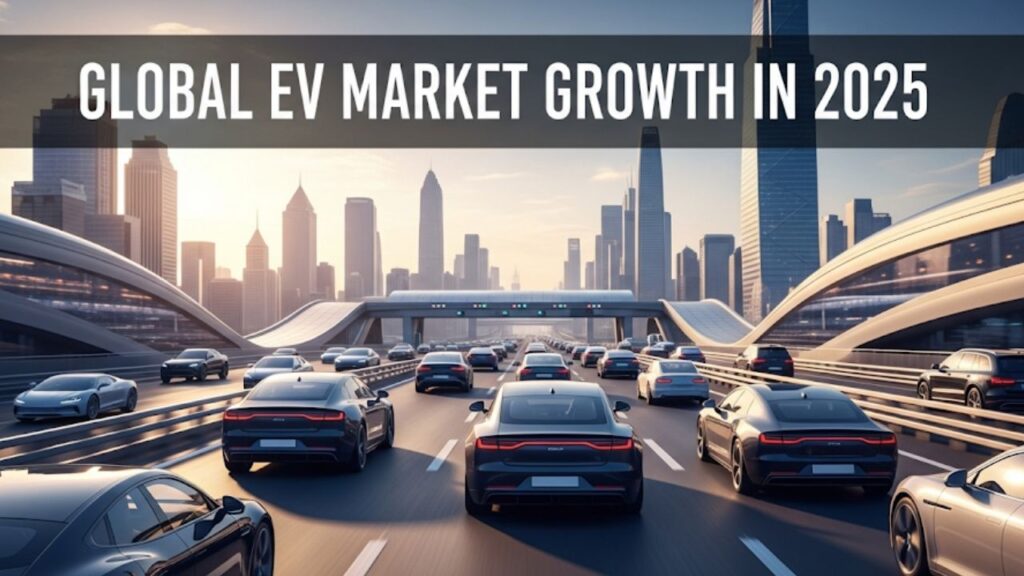
What Is Driving the Global EV Market Growth in 2025?
The EV market will continue to grow strongly in 2025, when world markets are seen between 15.1-22 million units (up from 25-30% on 2024). Several factors are driving this growth:
1. Declining Battery Costs
Battery technology in general, but particularly lithium-ion batteries, continues to make deep strides in cutting production costs, which in turn cuts the cost of EVs. Battery prices are falling because of an overcapacity in manufacturing, especially in China, where factories are operating below 50% of capacity, according to BloombergNEF.
The declining cost of batteries has opened the door to less expensive electric vehicles, with some models now costing less than $40,000, including incentives such as U.S. federal tax credits.
2. Supportive Government Policies
All over the world the governments are coming up with EV driver adoption to accelerate. Sales in China are being spurred by subsidies of up to 10,000 yuan to trade in old cars for EVs, with the vehicles set to make up almost 30% of new car sales by 2025.
In Europe, where CO2 emission regulations such as the EU’s 2025 targets are driving car manufacturers to focus on EVs, EV sales are expected to account for 25% of sales. Developing markets, including India and Brazil are also announcing incentives like India’s EV Policy 2025, which will give subsidies from ₹5,000 to ₹10 lakh.
3. Consumer Demand for Sustainability
Increasing environmental consciousness is turning consumer choices towards EVs. Younger generations in particular are placing an emphasis on sustainability, spurred by global efforts such as the United Nations’ Sustainable Development Goals.
EVs boast zero tailpipe emissions, less noise pollution, and lower running costs than internal combustion engine (ICE) vehicles, which is why buyers concerned about the environment may well plan for one.
4. Expanding Charging Infrastructure
The expansion of charging infrastructure addresses range anxiety, a significant hurdle to EV acceptance. China is in the lead with extensive charging networks, while Europe and North America are developing a public and home charging infrastructure.
Home charging still works out at 25-60% cheaper per mile than gasoline, which will continue driving adoption, according to BloombergNEF. Fast-charging stations for fleets are still essential, though, Mornet said.
How Will Regional Markets Contribute to EV Growth?
The global EV market will grow in 2025 at different rates depending on the region, with China, Europe, and North America at the forefront, whereas some emerging markets, including Southeast Asia and India, will make faster development.
China: The Global EV Leader
China is set to lead the way, representing 60% of global EV sales in 2025, with one in three new cars being electric. This growth is fueled by strong government policies in the country, competitive prices, and local manufacturing.
Admittedly this is pretty cheap for even the most basic EV. For example, the BYD Dolphin Surf has a price of ~$25,000 in Europe, and that would point up China’s prowess at making cheap EVs. China’s market is too mature, with sales expected to hit 10 million units in 2025, despite fierce competition and price wars.
Europe: Policy-Driven Growth
The EV market share in Europe is anticipated to increase by 43% by 2025, to well over 20%. Countries such as Norway (where 88% of passenger car sales in 2024 will be battery electric vehicles) are leading the charge, and the new corporate tax cuts in Germany are stimulating fleet uptake.
The EU’s Vehicle Emissions Trading Scheme, plus ever-tighter CO2 targets, will also help add momentum to EV sales, despite reductions in some nations’ subsidies.
North America: Steady but Uncertain
And in the United States, E.V. sales are expected to jump 36 percent, accounting for 11.2 percent of the car market by 2025. But policy uncertainty such as the possible phaseout of federal EV tax credits by 2027 — could put the breaks on growth.
Canada’s market is down 20% because of frozen subsidies, but single charging standards such as Tesla’s North American Charging Standard (NACS) are greasing the wheels for growth.
Emerging Markets: Rapid Expansion
There, in places like Brazil, Vietnam and India, EV sales are exploding. Sales doubled to 125,000 in 2024 in Brazil, propelled by cheap imports from China, and will rise by 50 percent in 2025.
Battery-operated passenger vehicle production in India may grow by 140.2% to 301,400 units, boosted by schemes such as the Electric Mobility Promotion Scheme.
What Are the Key Trends Shaping the EV Market in 2025?
A number of trends can be pinpointed that are shaping the EV scene in 2025, both in terms of new technologies or updated vehicle segments.
Battery Electric Vehicle (BEV) Uptake
BEVs will be the most popular segment in the market, with a share of 67.8% in 2024, and demonstrate dominance still in 2025. Besides, they are more desirable than PHEVs due to their zero-emission effect and maintenance sensitivity.
Growth of Extended-Range EVs (EREVs)
EREVs, the second type of PHEVs that have onboard power generators, are the fastest-growing drivetrain type, with sales climbing 83% to 1.2 million units in 2024. Their 170-kilometer e-range is sufficient for most daily driving, and as a result they are a bridge for consumers that may not yet want to go “full electric.”
Expansion of Electric Trucks
Electric trucks are gaining a foothold, especially in China, where they’re forecast to make up 46 percent of truck sales by 2030. On the long haul, in Europe and the United States, the TCO of the BEV trucks is becoming even lower than that of the diesel trucks, thanks to lower energy costs.
Why are EVs Still Facing Challenges?
There are, however, obstacles that could stand in the way of growth for the EV market.
High Initial Costs
At 20-30% pricier than ICE cars in markets such as Germany and the U.S., EVs have not yet found favor with cost-conscious consumers. Despite the aging effects, battery prices would still not reach price parity with ICE by 2025-2028 in some segments.
Charging Infrastructure Gaps
And while charging networks are growing, inequities remain, especially in rural areas and in developing countries like India. Its range anxiety is still a worry, and the price to pay for public charging over at-home charging could still put off potential new purchasers.
Policy Uncertainty
At home, a potential curtailment of EV tax credits and fuel-economy regulations in the U.S. could slow progression. Elsewhere in Europe, cuts in supported prices are complicating matters in nations such as Germany and France, while strict emissions rules could mitigate these effects.
What Does the Future Hold for the EV Market?
The EV market’s rise in 2025 is a milestone on the path towards a wider electrification. EVs are projected to represent 40-50% of global car sales by 2030, with China potentially even reaching 80%.
Ambitious net zero scenarios see 66-95% of sales being EVs by 2035. This transformation will be underpinned by falling battery costs, more charging stations, and new, lower-cost models.
How Can Consumers and Businesses Prepare for 2025?
For consumers, 2025 brings a greater choice of EV options, with mid-priced models that balance performance and cost. Leasing options and incentives can broaden EVs’ reach.
Companies, especially fleet managers, need to consider investing in fast-charging infrastructure and forming partnerships with electric-vehicle makers to control the process. Being aware of developments in policies that affect homeowners and local incentives will be crucial to realizing the benefits.
Conclusion
The global market of EVs is estimated to expand by 2025, with sales expected to top 20M units, and these will be compounded by tumbling battery costs, policy support, and intensive consumer inclination. As the global power, China is leading the way, followed by Europe, North America, and emerging markets.
But despite challenges such as cost and infrastructure gaps, the path toward electrification is evident. Equipped with knowledge and ready to take advantage of incentives offered on the market, consumers and businesses can be instrumental in this revolutionary period in safe and sustainable mobility.